Firefly

How might we improve people's perceived and objective safety, while walking alone?
Context:
Sep. 2019 - Dec. 2019
Program: M.S. HCDE
School: University of Washington
Teammates:
Sudipti Singh & Emily Cho
Contributions:
-
Helped conduct competitive product analysis & interviews
-
Helped define information architecture
-
Wrote UX microcopy
-
Prototyped micro-interactions
-
Led creation of product specification document
-
Ideated revenue model
-
Named design solution
Problem Space
People walk alone to many places: to school, to work — the list goes on. Most of the time walking alone is innocuous. However, most people can recall a time when they sped up their pace, looked over their shoulder, and clutched their phone a little tighter while walking alone. Whether the threat was real or perceived, the fear they felt was real. My team and I sought out to address this.
Research
Firefly was the product of an exploration into how we might help people feel and be safer, while walking alone. The exploration took the form of the following questions, which we answered through interviews, literature reviews, and competitive product analyses.
What is safety?
Safety is two-dimensional. There is objective and subjective safety. Objective safety represents the actual occurrences of crime incidents, whereas subjective safety refers to the feeling or perception of safety.
What factors contribute to people's feelings of safety while walking alone?
Some factors that either increased or decreased participants feelings of safety included:
-
How well-lit an area is
-
How trafficked an area is
-
The objective and perceived safety of an area
-
Objects (backups, weapons, etc.)
Who feels unsafe while walking alone?
We inquired into different diverse populations, including racial/ethnic minorities and people of varying sexual and gender identities, about their feelings of safety while walking alone. We wanted to know if there was a relationship between participants' demographics and their feelings of safety while walking alone. Respondents did not find their demographic characteristics to be related to their feelings of safety while walking alone.
How is personal safety while walking alone currently being addressed? What solutions exist?
One solution to personal safety, while walking alone, is personal safety apps. Most personal safety apps included in our analysis offer users just-in-time interventions that allow users to alert people, like emergency services, to their crisis.
Interview participants said, while they liked the interconnectivity and location tracking features, it was unlikely they would use such apps. Participants reasoned that such apps would not adequately serve them, as they felt the apps' solutions were retroactive and unlikely to "save [their] lives at that moment."
Design Solution
Firefly is a personal safety solution built for everyone — because there is no one kind of person who feels unsafe while walking alone. The solution consists of a mobile app, through which users can rent a drone for the duration of their walk.
The App
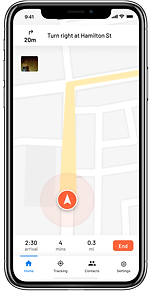
Through the mobile app, users can add trusted contacts to create a safety network. When users start a walk, trusted contacts, who the user is sharing their location with, will receive a notification. Trusted contacts will be able to view the video stream of the walk and the users location.
Although the goal of Firefly is to prevent users from experiencing crises, they do happen. The safety network is essential in addressing and mitigating said crises, as a trusted contact watching the video stream would likely be better equipped to get help than a person who is in flight or fight mode.
The Drone
The drone is equipped with features that help users reach their destinations safely and without distractions: lighting, video recording and streaming, GPS location tracking, and wayfinding features. From the drone, a light is cast, with the area and brightness similar to that of a street light. The light, along with lighting the path, provides increased peripheral awareness. The drone also incorporates wayfinding features by projecting directional symbols, such as arrows, onto the ground. The wayfinding features helps prevent users from being distracted by their phones.
The high-fidelity prototype can be viewed here.


